
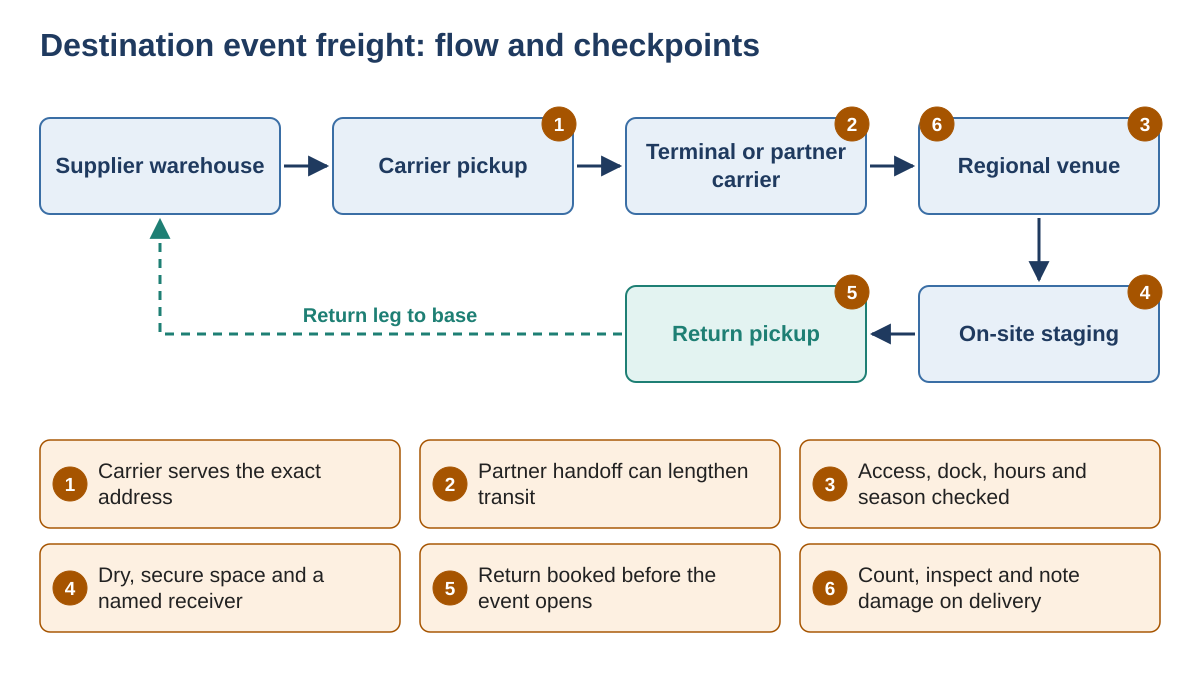

For regional events, freight planning starts at the destination: confirm road and dock access, receiving hours, who will sign for deliveries and whether the carrier serves that location directly. Then book inbound freight with time to spare, plan on-site staging, and arrange the return before the event begins. Rural and resort locations can add access charges, longer transit and fewer delivery options than a city address.
Regional events keep a whole network of businesses busy. Rental companies supply staging, furniture and décor. Printers ship signage. Equipment suppliers send audiovisual cases, catering hardware and branded merchandise. Many of these events take place away from city centres, at resorts in the Laurentians or Muskoka, conference lodges, vineyards or festival grounds, where freight logistics look very different from a downtown delivery.
For the suppliers behind those events, a late or damaged pallet is not just a freight problem. It can mean an empty stage or a missing booth on opening day. This guide covers how to plan business freight to destination venues, with a focus on less-than-truckload (LTL) shipments in Quebec and Ontario.
Freight to a destination venue has more checkpoints than a city delivery, from access and coverage to on-site staging and the return leg.
Why Is Freight to Destination Venues Different?
Access is less predictable
Resort roads, gravel lanes and venues without loading docks can restrict truck access. Ask the carrier about remote-area or limited-access charges and whether the road, turning area and unloading point are suitable for its equipment. Use the exact address, site photos where appropriate and current access conditions; do not assume service to a nearby town means service to the venue.
Coverage varies by postal code
Not every carrier serves every rural postal code with its own trucks. Some hand freight to a partner carrier for the final leg, which can lengthen transit. Confirm coverage for the exact delivery address, not just the nearest town.
Seasons change the rules
Spring is a special case in Quebec. Each year the provincial transport ministry sets thaw period dates for three zones, during which heavy vehicles must carry reduced loads on public roads. Carriers plan around these restrictions, so spring events in affected areas deserve extra lead time. Winter storms and summer tourist traffic bring their own delays.
A Step-by-Step Plan for Destination Freight
Survey the site before you quote
Ask the venue the questions carriers will ask you. Is there a dock or a forklift? Can a full-size truck turn around? Are deliveries restricted to certain hours or days? Who will be on site to receive freight, and with what phone number?
Choose the right delivery point
Sometimes the venue itself is not the best consignee. A nearby business address with a dock, the event organizer’s advance warehouse, or a local supplier’s premises may accept freight more easily, with a short local move to the site afterwards.
Coordinate with other suppliers
At larger events, several suppliers may be sending freight to the same site in the same week. Ask the organizer whether deliveries are scheduled in windows and whether a single receiving point is planned. Arriving inside an agreed window, with your consignee name and booth or zone marked on every unit, makes it far more likely your freight is received promptly and stored in the right place.
Book inbound freight with a buffer
Treat the carrier’s transit time as an estimate and add buffer days for rural legs and partner handoffs. If the date is fixed, ask separately about a receiving appointment and any guaranteed service. An appointment alone does not guarantee arrival; confirm the actual service conditions and cost.
Plan on-site staging
Freight that arrives early needs a dry, secure place to wait. Agree with the venue where pallets will be stored, who is responsible for them, and whether the space is protected from weather.
Arrange the return leg early
Event teardown is fast. Keep packaging and pallets for the return trip, prepare return labels in advance, and book the outbound pickup so it is confirmed before the first guest arrives.
Receive Carefully and Document Problems
At delivery, count pieces against the paperwork and note visible damage or shortage before signing, with photos where practical. Notify the carrier promptly through its claims process. For example, Ontario’s general-freight conditions include written-notice periods of 60 days after delivery or nine months after shipment for non-delivery, and separate final-claim requirements. Those are not a universal deadline for every shipment or insurance policy: check the applicable terms before shipping, retain evidence and act promptly.
Liability Versus Insurance for Rental Equipment
Rental equipment may be valuable relative to its weight. Quebec’s heavy-vehicle user guide describes a default indicated value of $4.41 per kilogram unless another value appears on the bill of lading. The applicable law, contract, exclusions and circumstances determine liability; the weight-based figure is not cargo insurance or a promised payout.
Illustrative example: assume an entire 80 kg case worth $12,000 is lost, liability is established and a $4.41-per-kilogram ceiling applies. The ceiling is $352.80, leaving $11,647.20 above it. That amount is potential exposure, not a freight charge. An accepted declared value may change the contractual limit; separate cargo insurance has its own exclusions, deductibles and claims requirements. Discuss the actual equipment and rental arrangement with the carrier and insurer before shipping.
Destination Site Checklist
| Site check | Why it matters |
|---|---|
| Truck access and turning room | Determines whether a full-size truck can reach the site |
| Loading dock or forklift | Helps determine the unloading arrangement, such as approved tailgate service |
| Receiving days and hours | Avoids failed attempts and redelivery charges |
| Named receiver and phone | Someone must count, inspect and sign |
| Carrier coverage for the exact address | Partner handoffs can add transit time |
| Seasonal restrictions | Spring thaw and winter weather affect scheduling |
| Storage space on site | Protects early arrivals from weather and loss |
| Return pickup booked | Prevents freight being stranded after teardown |
Comparing Carriers for Regional Lanes
Because coverage and access charges vary so much on regional lanes, comparing several carriers for each event pays off. Suppliers based in Quebec or Ontario can use Truxweb to send one LTL quote request to multiple carriers, weigh price against estimated transit, book the preferred option and get email alerts at dispatch, pickup and delivery. For destination venues in particular, confirm with each booking that the carrier serves the exact address and offers any tailgate or appointment service the site needs.
Conclusion
Freight for regional events rewards suppliers who start at the destination. Check access, coverage and seasonal rules first, choose the most practical delivery point, book with a buffer, stage freight safely, and confirm the return before the event opens. Add careful receiving and a clear decision on value coverage, and the logistics will support the event instead of threatening it.
Frequently Asked Questions
Can LTL carriers deliver to resorts and rural venues?
Often, yes, but coverage and charges vary by carrier and exact address. Some carriers use partners for the final leg, and access charges may apply.
Who should sign for event deliveries?
A named person who can count the pieces, inspect them and note any damage on the delivery receipt before the driver leaves.
What happens if nobody is there to receive the freight?
The carrier may return it to the terminal, store it or attempt redelivery, and published tariffs charge for those services. A confirmed receiver reduces that risk; keep a backup contact and escalation plan.
Do spring road restrictions affect event deliveries?
They can in Quebec, where thaw period load limits apply to heavy vehicles each spring. Ask carriers how the restrictions affect your lane and timing.